Honeycomb paper vs EPS (thermocol) for appliance and industrial packaging
Both materials protect products in transit, but in different ways. A practical comparison for appliance and industrial shippers: protection, shaping, tooling, storage, moisture and regulation.

Hexacell team
7 min read
Short answer: EPS (expanded polystyrene, widely called thermocol in India) is a moulded plastic foam that cushions by compressing. Honeycomb paper is a paper structure of connected hexagonal cells that gives stiff vertical support and cushions by crushing in a controlled way. EPS suits complex moulded shapes made in high volume. Honeycomb paper suits box-like products, heavy or stacked loads, and buyers who want a paper-based pack. Neither is better for every product. The right choice depends on weight, fragile areas, the journey and your material policy, and should be confirmed with a prototype.
How each material protects a product
EPS: foam that compresses
EPS is made from polystyrene beads expanded and fused into a mould. The result is a light foam block made of closed cells. On impact the foam compresses and absorbs energy, and it is usually moulded to wrap closely around the product, for example the end caps on a television or a washing machine.
Honeycomb paper: a structure that supports, then crushes
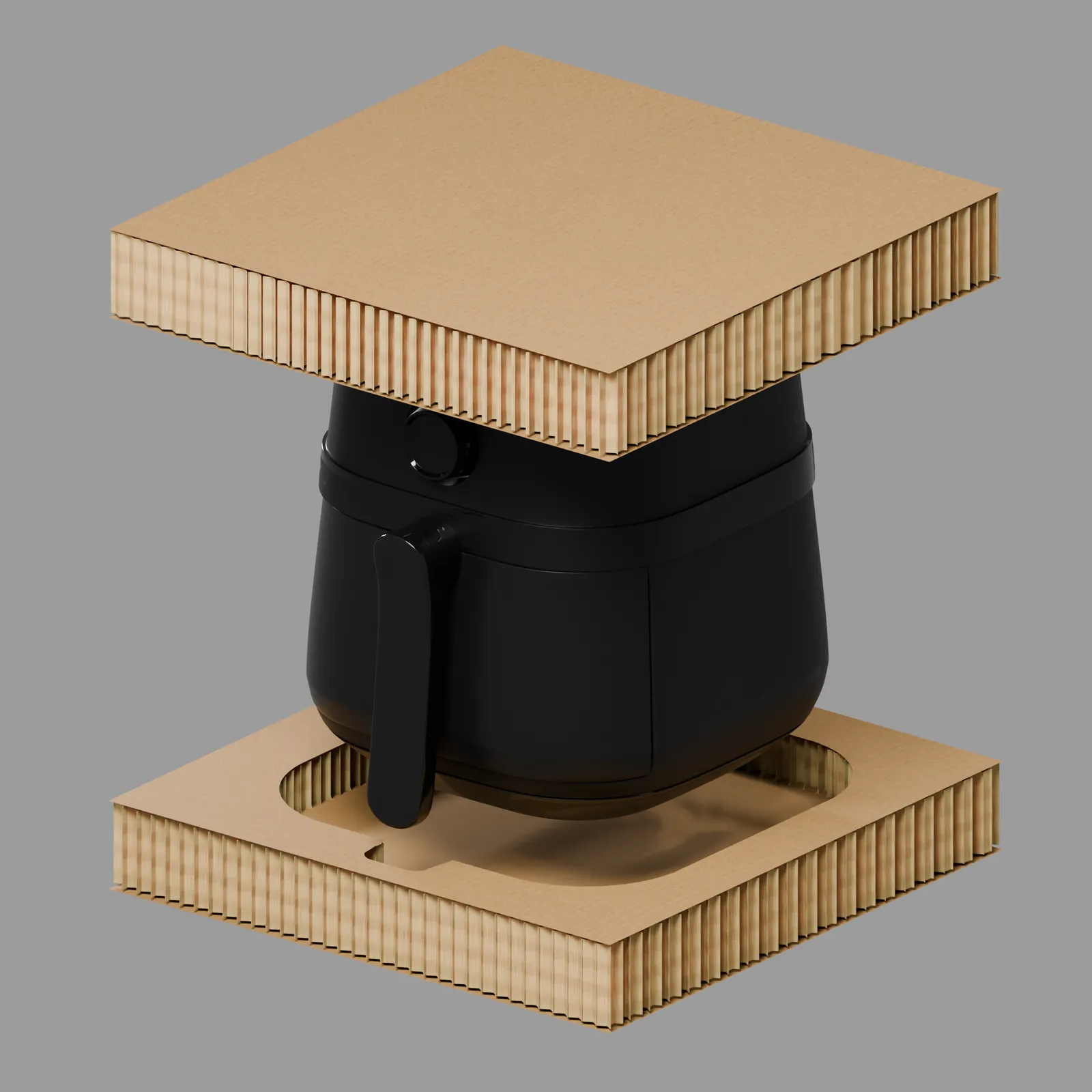
Honeycomb board is built from thin paper walls bonded into hexagonal cells and faced with paper liners. Because the walls stand on edge and share their sides, the board resists loads from above well for its weight. Under a strong impact the cell walls fold progressively, which cushions the product. The protection comes from the structure, so cell size, board thickness and paper grade are chosen for each application.
Side-by-side comparison
| Factor | EPS (thermocol) | Honeycomb paper |
|---|---|---|
| Material | Expanded plastic foam | Paper and adhesive |
| How it protects | Compresses to absorb impact | Supports vertical load; cell walls crush to absorb impact |
| Shaping | Moulded to complex 3D shapes | Cut, die-cut, layered and folded from flat boards and profiles |
| Tooling | A mould for each shape | Usually cutting or die-cutting; no foam mould |
| Supplied as | Finished, bulky shapes | Many components can be supplied flat |
| Moisture | Not affected by water in the same way as paper | Needs planning for humidity and wet storage; water-resistant options can be discussed |
| End of life | Disposed of as plastic | Disposed of as paper-based packaging; recyclability depends on paper, adhesive, coatings and local facilities |
Where honeycomb paper is a strong candidate
Appliances and box-shaped products
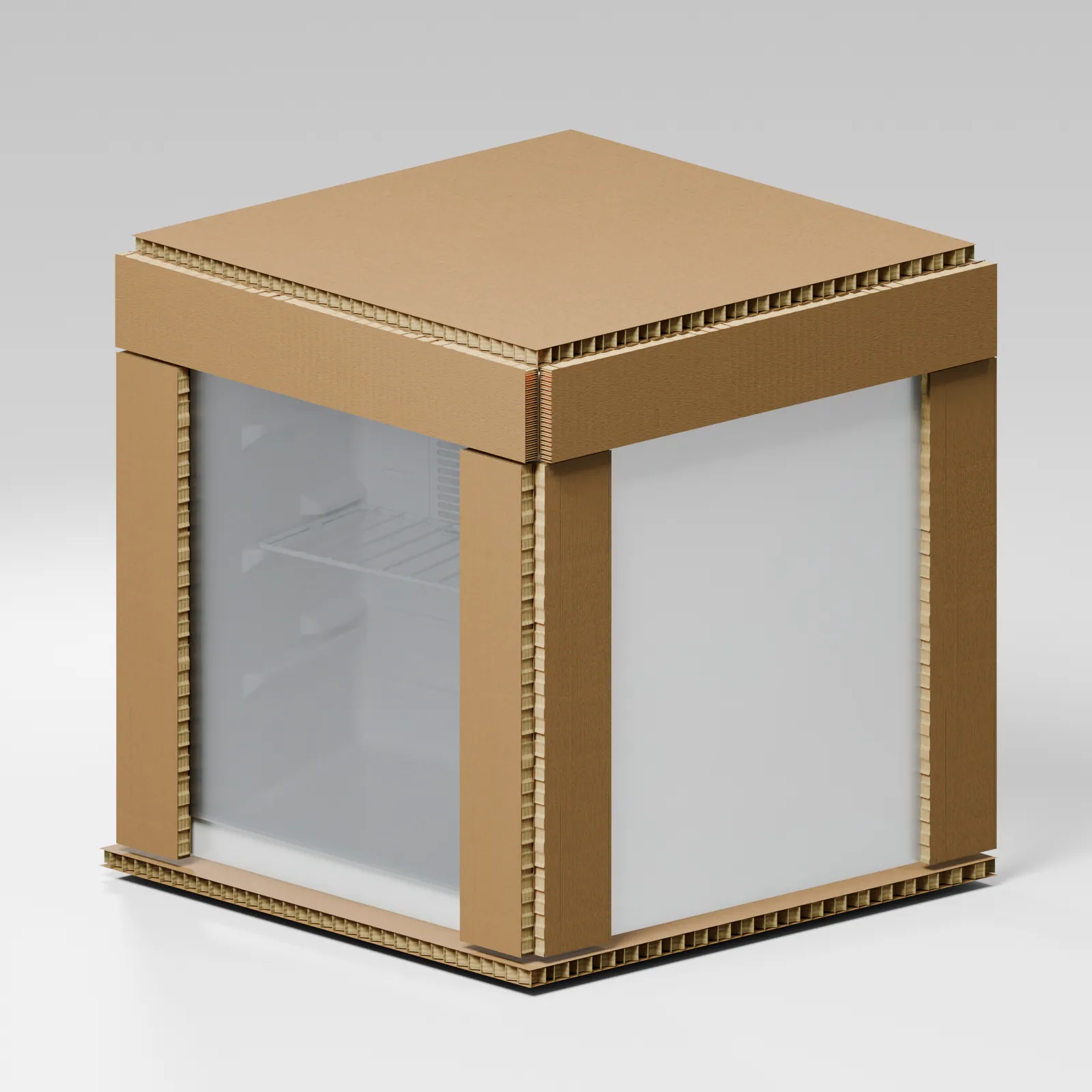
Refrigerators, chillers, microwaves, air conditioners and TVs are mostly box-like, with large flat panels, glass and corners that need protecting. Honeycomb components cover these well: a shaped base, corner protectors or corner posts, side panels, a top cap, and fillers and spacers around handles or controls. See the illustrative concepts on our appliances application page.
Heavy and stacked loads
Where units are stacked in a warehouse or loaded on pallets, vertical support matters as much as cushioning. Corner posts and angle and edge boards help a stack carry load and help a pallet load travel as one unit.
Industrial goods, parts and bulk loads
Motors, panels, rolls, drums and parts are often better served by die-cut honeycomb boards, layer boards and paper crates or pallet boxes than by moulded foam. See industrial equipment applications.
Changing product ranges
Every new EPS shape needs a mould. Honeycomb components are made to size from boards, which can make it easier to adapt packaging when models or sizes change.
Where EPS may still fit, or a combination works
- Highly curved or intricate geometry that a moulded cavity follows closely. Layered or die-cut honeycomb inserts can sometimes do the same job, but this needs to be checked.
- Very wet conditions where paper would need extra treatment.
- Mixed packs. Some packs use paper structures for support and a smaller amount of another material at one specific contact point. Be clear about your goal: if you want a fully paper-based pack, say so in the brief.
Regulation and material policy in India
Two points are often misunderstood.
- The 2022 single-use plastic ban did not ban EPS packaging. The Plastic Waste Management (Amendment) Rules, 2021 prohibited a list of identified single-use plastic items from 1 July 2022. The list includes "polystyrene (Thermocol) for decoration", not protective transport packaging (PIB, Ministry of Environment, Forest and Climate Change).
- Plastic packaging carries Extended Producer Responsibility (EPR) obligations. Guidelines notified on 16 February 2022 set mandatory targets for producers, importers and brand owners, covering the recycling of plastic packaging waste, reuse of rigid plastic packaging and use of recycled content (PIB, Plastic recycling targets). Check with your compliance team how your current packaging is classified and what it means for you.
Many buyers also face customer requirements, especially in export markets, that favour paper-based or easier-to-separate packaging. These are worth capturing in your brief alongside the technical needs.
How to compare the two for your product
- Start from today's damage. Where does the current EPS pack fail, and where does it work well?
- Map weight and fragile areas. Note the centre of gravity, glass, displays, controls and protruding parts.
- Describe the journey. Manual handling, forklifts, stacking height, road, sea or air, and storage conditions.
- Share the current pack. Photos, drawings or a sample of the EPS parts give a direct starting point.
- Prototype and test. Hexacell's custom packaging process moves from understanding the product to design, a physical prototype, and testing for impact, drop, vibration and compression, then optimises for protection, material use and cost before implementation.
- Check the packing line. Make sure operators can assemble and place the new components easily.
Frequently asked questions
Can honeycomb paper replace thermocol in appliance packaging?
In many appliance packs it can be considered as an alternative. Bases, corner posts, side panels, caps and fillers made from honeycomb paper cover the main protection points of most box-shaped appliances. Whether it can replace a particular EPS part depends on the product's weight, fragility and shape, so a prototype trial is the reliable way to decide.
Is thermocol packaging banned in India?
No general ban applies to EPS used as protective packaging. The ban from 1 July 2022 covers listed single-use items, including polystyrene (thermocol) for decoration. Plastic packaging is, however, covered by Extended Producer Responsibility guidelines, so check your obligations with your compliance advisor.
Does honeycomb paper cushion as well as EPS?
They cushion differently, so there is no general answer. EPS compresses as a foam; honeycomb paper supports load and then crushes progressively. Cushioning depends on cell size, board thickness, paper grade and the design of each component, so performance should be compared by testing the packed product.
What should I send to compare my EPS pack with honeycomb paper?
Send the product model, dimensions and weight, photos or drawings of the current EPS parts, any damage you see today, and how the product is stacked, handled and shipped. You can share your requirements through the enquiry form.
Sources
- Press Information Bureau, Ministry of Environment, Forest and Climate Change. "Ban on Single Use Plastics" (12 December 2022). https://www.pib.gov.in/PressReleasePage.aspx?PRID=1882855
- Press Information Bureau, Ministry of Environment, Forest and Climate Change. "Plastic recycling targets" (8 December 2022). https://www.pib.gov.in/PressReleasePage.aspx?PRID=1881760